Ross
The first European to explore the district was surveyor Charles Grimes who passed through the area while mapping Tasmania's central area including parts of what later became known as the Macquarie River. On an expedition in 1821, Governor Lachlan Macquarie passed through the area himself, naming it after Ross Priory, seat of Hector McDonald Buchanan, as he recorded in his journal,
I named our last Night's Station "Ross", in honour of H. M. Buchanan Esqr. – that being the name of his Seat on Loch-Lomond in Scotland; this part of Argyle Plains on the Right Bank of the Macquarie River being very beautiful and commanding a noble view.
Later that year, a timber bridge was built over the river and subsequently Ross became an important stopover on road journeys between Launceston and Hobart. Shortly afterward, cattle were being run on Crown land at Ross, to be used as working bullocks, and others were used as milch cows for people holding government posts. Ross developed as a base for the local garrison and became a centre for trade for the surrounding district. Between 1848 and 1854 approximately 12,000 female convicts passed through the Female Factory
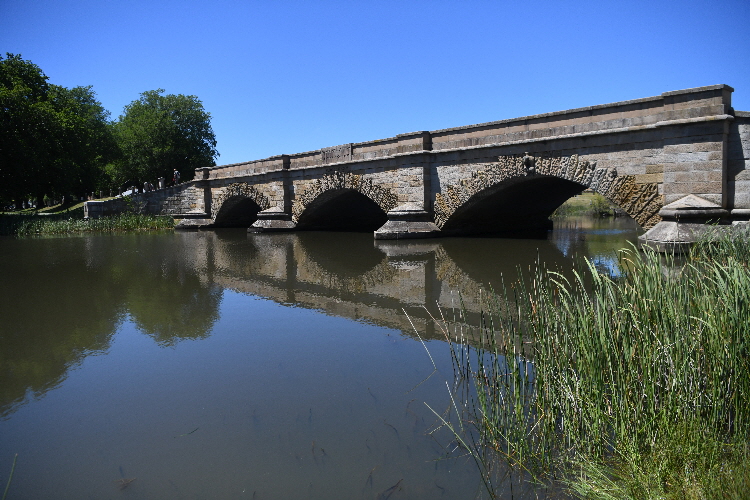
Ross Post Office opened on 1 June 1832. In 1836 the stone bridge, known as Ross Bridge, was completed.
By the time of Australian Federation in 1901, the permanent population had grown to 311 and the wider area had become known as a fine wool growing district. At this time Ross had four churches, a post and telegraph office, a savings bank, one hotel, and a town hall and library.
While at Ross I also took a side trip to Tooms Lake
- Home
- About
- Traveller
- Snows travels
- Herman and Carol
- New Zealand
- Asia
- Europe
- Australian
- Whitsundays 2000
- Adelaide
- Becoming a grey Nomad
- First Real Test
- Corner Country
- Perth Solo Trip
- Winton Trip
- Opera In The Outback
- Tasmania
- The North Coast - Western End Pt1
- North Coast - Eastern end Pt 1
- Turning South
- Hobart
- Heading Further South
- Heading to the West Coast
- And to the west Coast
- The North Coast - Western End Pt2
- North Coast - Eastern end Pt 2
- Summing up
- Turning South
- St Helens
- St Marys
- Campbell Town
- Ross
- Ross Gallery
- Ross Bridge
- Tooms Lake
- Oatlands
- Richmond
Copyright
Viewgrant Pty Ltd 2025
Richardsclan
Becoming a Grey Nomad
TASMANIA