Beaconsfield
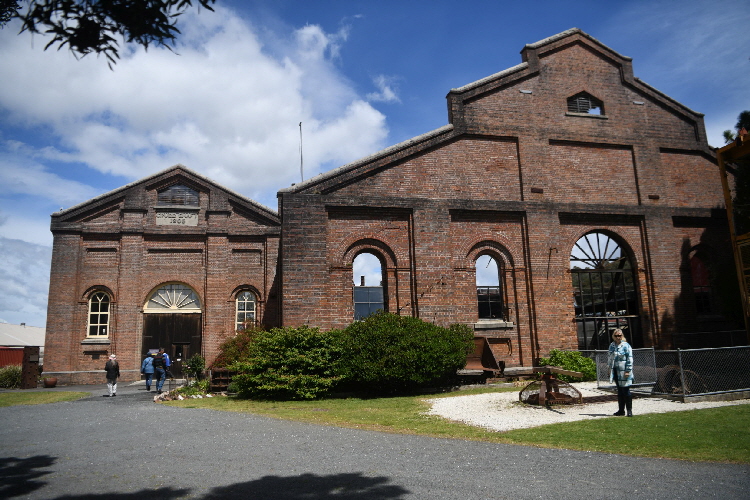
The area around Beaconsfield was first explored by Europeans in 1804 when William Paterson led an expedition to Port Dalrymple and established a settlement at York Town. Settlement of Beaconsfield itself, then known as Brandy Creek did not occur until the 1850s. Limestone mining led to the discovery of gold in 1869. Gold mining began in 1877 and the area's population boomed. Brandy Creek Post Office opened on 1 December 1877 and was renamed Beaconsfield in 1879.
The town was named Beaconsfield in 1879 in honour of Benjamin Disraeli, 1st Earl of Beaconsfield, who was the prime minister of the United Kingdom at the time. In 1881, the Beaconsfield newspaper was called the Beaconsfield Tickler.
old was first discovered in Beaconsfield in 1847. When the gold rush hit Victoria and New South Wales in 1851 and the Tasmanian Government offered a reward for the discovery of a payable goldfield. In 1877 the cap of a payable gold reef was discovered on the eastern slope of Cabbage Tree Hill by brothers William and David Dally. This became known as the fabulous Tasmanian Reef. In October 1877 the Dally brothers sold their claim on the Tasmania Reef to William D Grubb & William Hart for 15,000 pounds, and 1/10 share in any company formed.
At the peak of the gold rush 700 men were employed in the gold mine and 26 tonnes of gold was recovered.
On Tuesday 25 April 2006, a small earthquake caused a rock fall in the Beaconsfield gold mine. Fourteen miners escaped safely, one miner, Larry Knight, was killed, and the remaining two, Todd Russell and Brant Webb, were trapped in a shaft approximately one kilometre underground. The two trapped miners were found alive five days later on Sunday 30 April. Rescue operations continued for nearly two weeks until the two miners were freed on Tuesday 9 May.
The Beaconsfield gold mining operations finally ended with the closure of the mine in June 2012
- Home
- About
- Traveller
- Snows travels
- Herman and Carol
- New Zealand
- Asia
- Europe
- Australian
- Whitsundays 2000
- Adelaide
- Becoming a grey Nomad
- First Real Test
- Corner Country
- Perth Solo Trip
- Winton Trip
- Opera In The Outback
- Tasmania
- The North Coast - Western End Pt1
- North Coast - Eastern end Pt 1
- Turning South
- Hobart
- Heading Further South
- Heading to the West Coast
- And to the west Coast
- The North Coast - Western End Pt2
- North Coast - Eastern end Pt 2
- Summing up
- The North Coast - Western End Pt1
- Beaconsfield
- Beaconsfield Photos
- Cradle Mountain
Copyright
Viewgrant Pty Ltd 2025
Richardsclan
Becoming a Grey Nomad
TASMANIA